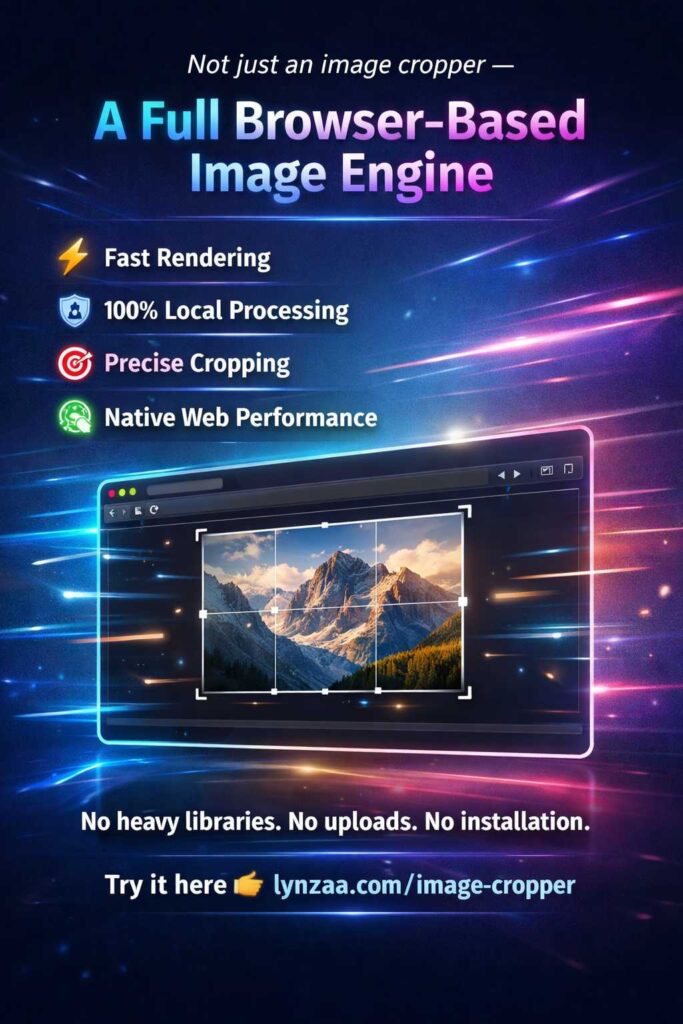
Rethinking Online Image Cropping: A Modern Browser-Based Approach
Most online image cropping tools appear simple at first glance. You upload an image, adjust a selection box, press a button, and download the result.
But beneath this simplicity, many platforms rely on heavy backend systems, slow processing pipelines, and unnecessary complexity that affects both speed and privacy.
Today’s users expect something different: instant performance, strong privacy, and tools that work without installation or account creation.
This shift is driving a new generation of browser-based applications that run entirely on the user’s device.
The modern approach focuses on doing all image processing directly inside the browser, avoiding external servers entirely.
This creates a faster, more private, and more efficient experience for everyday users.
The Limitations of Traditional Online Editors
Many conventional image editing platforms still depend on server-side processing. In this model, every action requires sending the image to a remote server, processing it there, and returning the result back to the user.
This workflow introduces several drawbacks:
- Noticeable delays caused by image uploads and downloads
- Uncertainty regarding how user images are stored or handled
- Increased infrastructure and maintenance costs
- Heavy reliance on stable internet connections
Even simple edits can feel slow and inefficient when every operation depends on network conditions.
A Shift Toward Local Processing in the Browser
A more modern solution avoids servers entirely by processing images locally within the browser.
In this model, the image never leaves the user’s device.
All editing operations are handled using built-in browser technologies, making the experience immediate and responsive.
This approach offers clear advantages:
- Faster interaction with no upload delays
- Stronger privacy since files remain on the device
- Lower bandwidth usage
- Instant preview of edits
Why Pure JavaScript Makes a Difference
Lightweight image tools often rely on native JavaScript rather than large frameworks. While frameworks can simplify development, they often introduce unnecessary overhead.
Using pure JavaScript keeps the application fast, minimal, and easier to optimize. It also allows direct interaction with browser capabilities without additional abstraction layers.
This results in better performance, especially on lower-end devices and mobile browsers.
The Role of HTML5 Canvas
HTML5 Canvas is one of the core technologies behind modern browser-based image editing. It enables real-time drawing, transformation, and manipulation of images directly in the browser window.
With Canvas, developers can perform operations such as cropping, resizing, rotating, and exporting images without relying on external tools.
More importantly, Canvas supports real-time interaction, allowing users to see changes instantly as they adjust selections or modify images.
Privacy Through Local Image Processing
Privacy has become a major concern for users handling personal images online. Uploading files to unknown servers can raise questions about storage, access, and data retention.
Browser-based processing removes this concern entirely by keeping all files on the user’s device. No uploads are required, and no external storage is involved.
This creates a more secure and transparent editing experience.
Performance Advantages of a Local Approach
Eliminating server communication significantly improves speed. Without upload or download delays, editing becomes instant.
Modern browsers also benefit from hardware acceleration and highly optimized JavaScript engines, which make image processing extremely efficient.
The result is a smoother and more responsive experience, even when working with large images.
Minimalism as a Design Philosophy
Many modern web applications suffer from excessive complexity and unnecessary features. Lightweight tools take the opposite approach by focusing on one task and doing it well.
A dedicated cropping tool does not need to be overloaded with editing suites or advanced features that most users never use.
By reducing complexity, the interface becomes faster, cleaner, and easier to understand.
Mobile-First Accessibility
With most users accessing tools from mobile devices, responsiveness is essential. Browser-based image tools naturally adapt to different screen sizes without requiring separate applications.
This ensures a consistent experience across smartphones, tablets, laptops, and desktops.
No Installation, No Barriers
Traditional software often requires installation, updates, storage space, and system compatibility checks. Browser-based tools eliminate all of these barriers.
Users can simply open a web page and begin editing immediately, without setup or configuration.
Optimized for Real-Time Interaction
Smooth image editing requires efficient rendering. Modern browser tools are designed to maintain real-time feedback during user interactions such as dragging, resizing, or cropping.
This responsiveness improves usability and makes the experience feel more intuitive and professional.
The Evolution of Web Technology
Web browsers have evolved far beyond static content display. They are now capable of handling complex applications that previously required desktop software.
Advances in JavaScript engines, graphics APIs, and hardware acceleration have made it possible to build powerful image processing tools directly in the browser.
The Value of Simplicity
For most users, simplicity is more valuable than advanced features. A fast and reliable cropping tool often delivers more practical value than a complex editing suite.
When tools are focused and efficient, users complete tasks faster and with less friction.
Looking Ahead
The future of web-based tools is moving toward fully browser-native applications. As web technologies continue to improve, more advanced tasks such as photo editing, video processing, and even AI-driven manipulation will run directly in the browser.
This shift reduces dependence on heavy software installations and moves computing power closer to the user.
Conclusion
Browser-based image cropping represents a broader transformation in how web applications are built and used.
By focusing on local processing, lightweight architecture, and privacy-first design, modern tools offer a faster and more secure alternative to traditional systems.
As technology continues to evolve, this approach will likely become the standard for many everyday digital tasks.
Recommended For You
- My Ideas by Lynzaa: A Smart Way to Organize Your Thoughts and Turn Ideas into Action
- The Smart Way to Resize Images Online Without Losing Quality
- The Ultimate Guide to Free and Powerful PDF Tools
- Free Invoice Generator Online, Create Invoices Free Instantly
- Favorite Links Manager: The Smartest Way to Organize Your Important Links