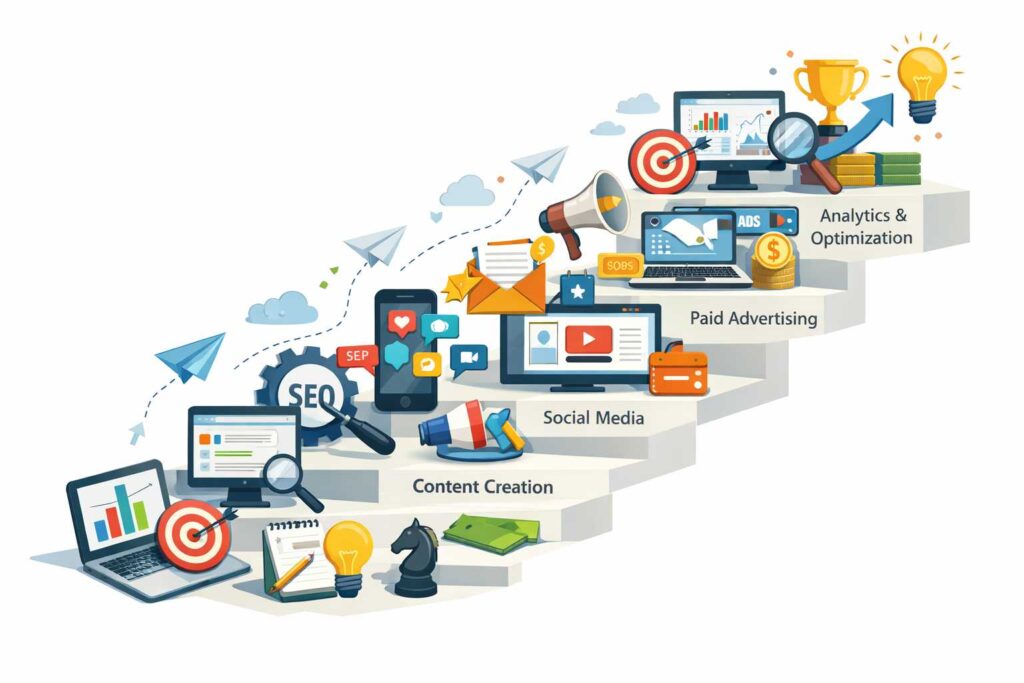
Digital marketing has become one of the most valuable skills in today’s digital world. Whether you want to start a new career, grow your business, work as a freelancer, or simply promote your own website, understanding digital marketing can open many opportunities. The best part is that anyone can learn it with the right roadmap and enough practice.
Many beginners feel overwhelmed because digital marketing covers several different fields, including search engine optimization (SEO), pay-per-click advertising (PPC), content marketing, email marketing, social media marketing, analytics, and conversion optimization. Trying to learn everything at once usually leads to confusion. A structured learning plan is much more effective.
This guide explains how to learn digital marketing step by step, helping beginners build practical skills instead of memorizing theory. By following this roadmap, you’ll understand which topics to learn first, how to practice them, and how to keep improving over time.
What Is Digital Marketing?
Digital marketing is the process of promoting products, services, or brands through online channels. Unlike traditional marketing, digital marketing allows businesses to reach highly targeted audiences, measure campaign performance, and optimize results using real data.
Today, businesses rely on digital marketing because consumers spend a large portion of their time online. People search on Google, watch videos, browse social media platforms, read blogs, and shop online every day. Companies need digital marketers to help them connect with these audiences effectively.
The main areas of digital marketing include:
- Search Engine Optimization (SEO)
- Pay-Per-Click Advertising (PPC)
- Content Marketing
- Social Media Marketing
- Email Marketing
- Affiliate Marketing
- Analytics and Data Tracking
- Conversion Rate Optimization
You don’t need to master every area immediately. Instead, start by understanding how each channel works before choosing one or two specialties.
Step 1: Understand the Basics of Digital Marketing
Before diving into advanced strategies, learn the basic concepts behind online marketing. Understand how websites work, why search engines rank pages, how advertisements reach audiences, and how businesses measure online success.
Focus on learning marketing fundamentals rather than chasing shortcuts. Every successful digital marketer understands customer behavior, user intent, and the importance of providing real value.
Learn How Search Engines Work
Search engines like Google organize billions of web pages and rank them according to relevance and quality. Learning how search engines crawl, index, and rank websites provides the foundation for SEO.
Study concepts such as keywords, search intent, backlinks, technical SEO, page speed, mobile optimization, and user experience. These factors play a major role in helping websites appear in search results.
Understand Your Target Audience
Successful marketing starts with understanding people. Learn how to identify your audience, discover their problems, answer their questions, and create content that solves real needs.
Instead of focusing only on selling, think about building trust. Helpful content often performs better than overly promotional material because users appreciate useful information.
“`html
Step 2: Learn Search Engine Optimization (SEO)
Search Engine Optimization, commonly known as SEO, is one of the most important digital marketing skills. SEO helps websites appear higher in search engine results without paying for every visitor. While it takes time to see results, SEO can generate consistent, long-term traffic when done correctly.
As a beginner, start by learning keyword research. Keywords represent the words and phrases people type into search engines when looking for information, products, or services. Understanding search intent allows you to create content that directly answers users’ questions instead of simply adding keywords to a page.
Master On-Page SEO
On-page SEO focuses on optimizing individual pages so search engines and visitors can easily understand the content. Learn how to write descriptive page titles, compelling meta descriptions, clear headings, internal links, image alt text, and well-structured paragraphs.
Good on-page SEO is not about keyword stuffing. Instead, it involves creating valuable, readable, and organized content that naturally includes relevant search terms while maintaining an excellent user experience.
Understand Technical SEO
Technical SEO ensures that search engines can efficiently crawl and index your website. Beginners should understand XML sitemaps, robots.txt files, HTTPS security, mobile responsiveness, page speed, structured data, and clean URL structures.
Even the best content may struggle to rank if technical issues prevent search engines from accessing or understanding your website properly.
Step 3: Learn Content Marketing
Content marketing is the foundation of nearly every digital marketing strategy. High-quality content attracts visitors, builds trust, improves SEO, supports email campaigns, and increases social media engagement.
Rather than publishing articles just to increase page count, focus on solving problems. Every blog post should answer a specific question or help readers accomplish a goal. Valuable content naturally earns shares, backlinks, and returning visitors.
Create Content People Want to Read
Before writing, research what your audience wants to know. Look for common questions, beginner challenges, industry trends, and practical tutorials. Then organize your content using clear H2 and H3 headings, short paragraphs, bullet points, and examples where appropriate.
Consistency is more important than publishing dozens of articles at once. Creating one helpful article every week is often more effective than publishing many low-quality posts.
Improve Your Writing Skills
Digital marketers spend a significant amount of time writing. Whether you create blog posts, landing pages, email campaigns, or social media content, strong writing skills improve engagement and conversions.
Write in a conversational tone, avoid unnecessary jargon, and explain complex topics using simple language. Readers appreciate articles that are easy to understand and immediately useful.
Step 4: Explore Social Media Marketing
Social media marketing helps businesses connect with audiences, build brand awareness, and drive traffic to websites. Each platform serves different audiences and content formats, so avoid trying to master every platform simultaneously.
Instead, choose one or two platforms that match your goals. Learn how algorithms work, understand audience behavior, create engaging posts, and monitor performance using platform analytics.
Focus on Engagement Instead of Followers
Many beginners become obsessed with follower counts, but engagement often matters more. Meaningful conversations, helpful content, and consistent posting usually produce better long-term results than chasing viral content.
Experiment with educational posts, videos, infographics, short tips, and community discussions to discover what resonates with your audience.
“`html
Step 5: Understand Pay-Per-Click (PPC) Advertising
While SEO focuses on earning organic traffic over time, Pay-Per-Click (PPC) advertising allows businesses to attract visitors almost immediately by paying for ad placements. Platforms like Google Ads and social media advertising networks enable marketers to target users based on keywords, interests, demographics, and online behavior.
As a beginner, you don’t need a large advertising budget to understand PPC. Start by learning how campaigns are structured, how bidding works, what Quality Score means, and why relevant landing pages improve campaign performance. A well-planned campaign can generate qualified traffic while keeping advertising costs under control.
Learn Campaign Optimization
Successful PPC campaigns require continuous optimization. Analyze metrics such as click-through rate (CTR), cost per click (CPC), conversion rate, and return on ad spend (ROAS). Small improvements in targeting, ad copy, or landing pages can significantly increase campaign performance over time.
Step 6: Master Email Marketing
Despite the popularity of social media, email marketing remains one of the highest-converting digital marketing channels. Unlike social platforms where algorithms control visibility, email allows businesses to communicate directly with subscribers who have already shown interest.
Learn how to build an email list ethically by offering valuable resources, newsletters, or downloadable guides. Avoid purchasing email lists because they often lead to poor engagement and may violate email marketing regulations.
Create Valuable Email Campaigns
Every email should provide value. Educational articles, product updates, exclusive offers, case studies, and practical tips help maintain subscriber interest. Keep subject lines clear, personalize content when appropriate, and include a simple call to action.
Step 7: Learn Analytics and Data Interpretation
One of the biggest advantages of digital marketing is the ability to measure nearly every action users take. Learning analytics helps you understand which marketing activities produce results and which require improvement.
Become familiar with metrics such as website traffic, bounce rate, average engagement time, conversion rate, traffic sources, and user behavior. Rather than relying on assumptions, make decisions based on real data.
Track Your Progress
Regularly reviewing analytics helps you identify successful content, high-performing marketing channels, and opportunities for optimization. Over time, data-driven decisions become one of your greatest competitive advantages.
Step 8: Build Real Projects
Theory alone will never make you an effective digital marketer. The fastest way to improve is by applying what you learn through real projects. Create a personal website or blog, publish helpful content, optimize pages for SEO, build an email newsletter, and share your work on social media.
Practical experience teaches lessons that no course can fully explain. You’ll encounter technical issues, content challenges, ranking fluctuations, and audience feedback—all of which contribute to your growth as a marketer.
Create a Digital Marketing Portfolio
Document your work as you gain experience. Include blog articles, SEO improvements, keyword research examples, social media campaigns, email sequences, and analytics reports. A strong portfolio demonstrates practical skills to clients and employers more effectively than certificates alone.
Step 9: Keep Learning and Stay Updated
Digital marketing evolves constantly. Search engine algorithms change, advertising platforms introduce new features, and consumer behavior shifts over time. Commit to continuous learning by following industry news, experimenting with new strategies, and refining your existing skills.
Successful marketers view learning as an ongoing process rather than a one-time achievement. Staying curious and adaptable will help you remain competitive throughout your career.
“`html
Common Mistakes Beginners Should Avoid
When learning digital marketing, many beginners make the mistake of trying to master every marketing channel at the same time. Although digital marketing includes SEO, PPC, social media marketing, content marketing, email marketing, and analytics, attempting to learn everything at once often leads to frustration. Instead, focus on one skill, practice it consistently, and gradually move on to the next area.
Another common mistake is spending too much time watching tutorials without taking action. Reading articles and watching videos can help you understand the basics, but real progress comes from applying what you learn. Build a website, publish content, optimize pages, and measure the results. Practical experience is the fastest teacher.
Many beginners also expect immediate results. SEO campaigns may take several months before showing noticeable improvements, while social media growth and email list building require patience and consistency. Digital marketing is a long-term investment rather than a shortcut to instant success.
Finally, avoid copying competitors without understanding their strategy. Learn from successful websites, but always create original content that provides unique value to your audience.
Frequently Asked Questions (FAQ)
Can I learn digital marketing by myself?
Yes. Thousands of successful marketers are self-taught. With high-quality learning resources, consistent practice, and real-world projects, you can build professional digital marketing skills without attending a traditional university program.
How long does it take to learn digital marketing?
Most beginners understand the fundamentals within three to six months of consistent study. Becoming highly skilled usually takes one to two years of continuous learning and practical experience.
Which digital marketing skill should I learn first?
SEO and content marketing are excellent starting points because they build a strong foundation for understanding search engines, user intent, website optimization, and content creation. Once comfortable with these topics, you can expand into PPC, email marketing, analytics, and social media marketing.
Do I need coding skills?
No. Basic HTML and CSS knowledge can be helpful, but most digital marketing tasks do not require advanced programming skills. Many successful marketers focus on strategy, content creation, analytics, and campaign management rather than software development.
Is digital marketing a good career?
Yes. Digital marketing continues to grow as businesses invest more in online advertising and digital transformation. Professionals with practical experience in SEO, PPC, content marketing, analytics, and email marketing are in demand across many industries.
Conclusion
Learning digital marketing step by step is one of the smartest investments you can make for your career or business. Instead of trying to master every discipline at once, build a solid foundation by understanding marketing principles, SEO, content creation, social media, PPC advertising, email marketing, and analytics. As you gain confidence, apply your knowledge through real projects and continue improving based on data and experience.
Remember that success in digital marketing does not come from memorizing definitions or completing online courses alone. It comes from solving real problems, creating valuable content, understanding your audience, and continuously testing new ideas. Every article you publish, every campaign you launch, and every metric you analyze contributes to your growth.
Whether your goal is to become a freelance marketer, work for a company, grow an online business, or increase traffic to your own website, following a structured digital marketing roadmap will help you develop valuable skills that remain relevant for years to come. Stay consistent, keep learning, and focus on delivering genuine value to your audience. Long-term success will naturally follow.